JP Morgan Private Bank Global Onboarding
The US Private Bank onboarding product is for internal users at JP Morgan - advisors, front office bankers, account operations, relationship onboarders, and others. However, it is no less important than client-facing products, as it is a foundational product to better serve clients and digitize business processes, creating huge efficiencies for the firm.
Global Onboarding was a huge initiative that spanned several workstreams across a central onboarding platform. Each triad of product owners, a UX designer, and software engineers, focused on one section of the onboarding process, from account information, party relationships, documents, to operations. I led design for the document delivery process, understanding the needs (jobs to be done), actors, processes, operating models and systems involved in signing, delivering, and approving documents for account opening.
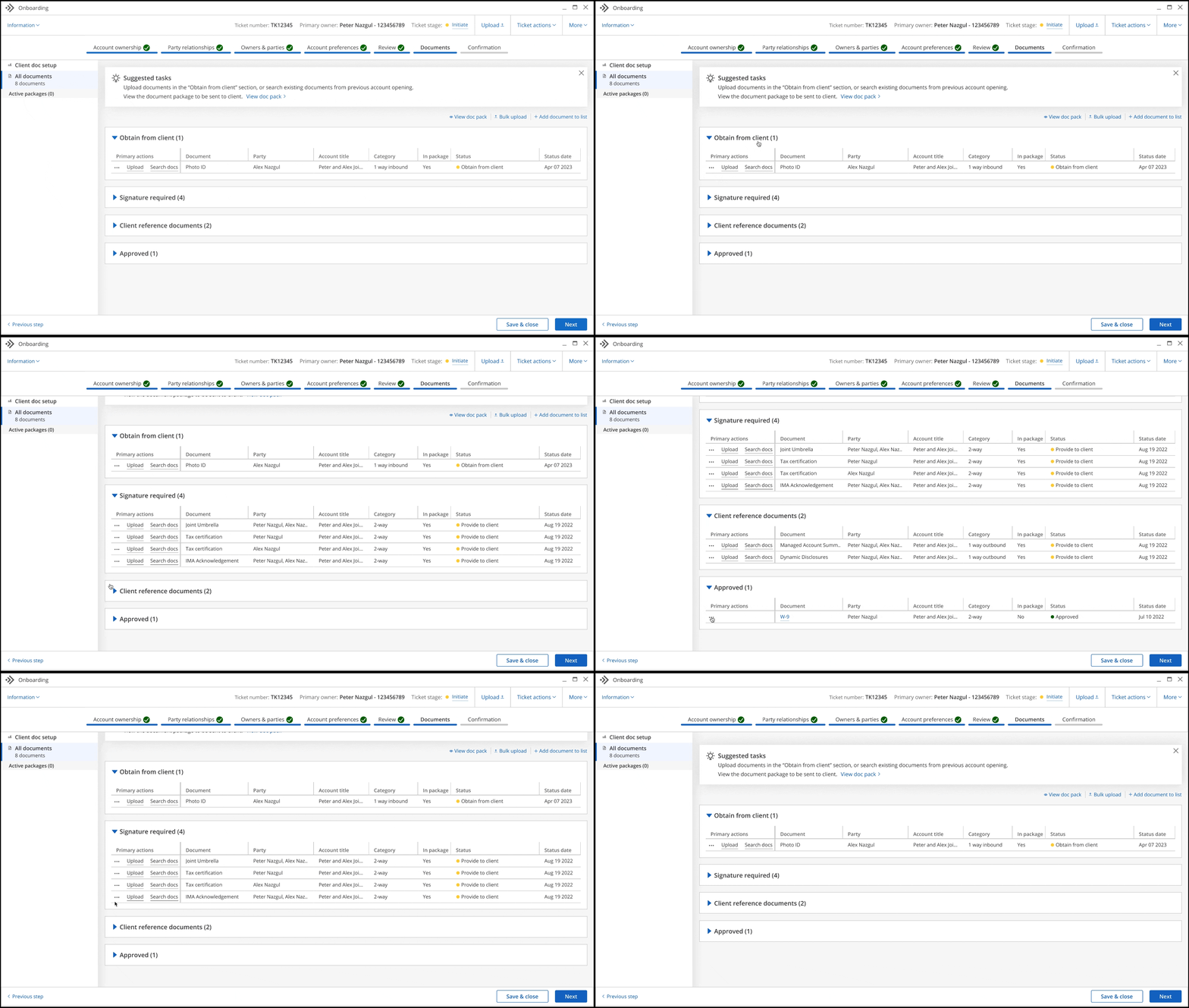
I redesigned and rethought the document structuring in onboarding, and created a new pattern for document management systems across the JP Morgan internal ecosystem, now utilized by thousands of advisors each day in lending, international onboarding, credit applications, and more.
Challenges
Convincing leadership to adopt the new pattern
When creating the new document experience, I strayed from existing design system patterns to better serve the needs of advisors. I had to build evidence for my case of a new pattern, and secure buy-in from business leaders to convince design leadership to adopt the pattern.
Siloed teams
I faced difficulties with three siloed teams delivering disconnected components of the document sending, delivery, and evaluation steps, so I stepped in to drive alignment. I learned to facilitate cross-functional workshops, clarified ownership, and established shared priorities, enabling successful integration and on-time feature delivery.
Stakeholder management
I was well-versed in leading design within my immediate product teams, creating workflows and prioritizing features; however I also needed to streamline ways of working with adjacent design teams, the design system auditors, and managing directors in the advisor-led business at the firm.
Process
1. Understand
Evaluate Business and Customer Needs
Learn about business requirements and the pain points in the current onboarding process
-
Discovered extensive back-and-forth communication loops slowing operations
-
Identified reliance on outdated tools, leading to inconsistency
-
Found unclear documentation and delivery processes that caused long onboarding times and knowledge gaps
-
Most of the pain points centered around the technical failures/lack of automation in the current system
Workflow Mapping and Understanding
I made flow charts and diagrams of pre and post document flows, connected them with the end to end experience, and confirmed them with product partners and prioritized necessary features that needed to be included in designs

2. Design iterations and usability testing
Research & Testing
Concept tests and validation we were heading in the right direction
-
Walk through the pre-sending documents flow with advisors and determine where they are confused, how they interpret the content, and their detailed feedback on the documents and signers pages. Does the design enable them to complete their responsibilities/job?
Set signing and delivery options for client documents

"Guided" experience for advisors to know what tasks they need to complete in the documents section

As different tasks are completed, the corresponding tasks disappear


Research Insights and Opportunities
1. Content and process was clear and concise for the most part, but there were some redundant and confusing items like the package tab, and the document accordion titles.
2. Optional vs required tasks: Different opinions about what is required or optional, need for flexibility
3. More functionality and assurance needed for the advisors: Upload docs, checking for missing docs, confirmation everything uploaded, minimize back and forth between different members of the onboarding team.
3. Second and third rounds of usability testing
Context: Refine all the usability issues brought to light in the focus groups and finalize the pre-doc process.
Goal: See if they can successfully complete their responsibilities: setting signers and sending the package to the client.
Notable changes:
-
New signing requirements from legal + streamlined process
-
Content changes to increase clarity and reduce confusion
-
Additional status updates and assurance

Final Release
Streamlined signing and delivery selection
Ability to customize signers if needed, and defaulted to Docusign to encourage digital processes.


Continuation of guided banners for advisors
Clean, clear, and descriptive document management
Content changes to suggested tasks, more descriptive document statuses, clear accordion headings, and validation of task completion


Project Learnings
Integrate early on
To prevent design escalations and back and forth with the design system team, I should have integrated with the design systems teams early on. For future projects, my manager and I created a new meeting and check-in cadence with the team so that our products would remain compliant.
Continue to create design artifacts
Journey maps, why templates, process diagrams, and alignment workshops were the most powerful tools I leveraged throughout the product development process. These methods helped drive decision-making and shared alignment across product, design, and software teams.